


Inertial Fusion Energy
The moment everything changed
On December 5, 2022, scientists at the National Ignition Facility (NIF) at Lawrence Livermore National Laboratory did something that had eluded researchers for six decades: they fired 192 laser beams at a peppercorn-sized fuel pellet and produced more fusion energy than the lasers delivered. Ignition — the holy grail of fusion research — had been achieved. Not once. Since then, the experiment has been repeated many times, with target gains continuing to improve.
For the photonics industry, this was not merely a physics milestone. It was a starting gun.
What laser fusion actually needs from photonics
Inertial fusion energy works by compressing a tiny deuterium-tritium fuel target using intense laser pulses — heating and pressurising it until hydrogen nuclei fuse and release energy. The NIF demonstrated this works. What it didn’t demonstrate is that it can work economically at scale.
A commercial IFE power plant will require lasers that are fundamentally different from anything built before. The NIF’s flashlamp-pumped neodymium-glass laser system achieves roughly 1% wall-plug efficiency and fires a handful of shots per day. A power plant needs to fire 10 to 20 times per second, every second, for decades. The only credible path to that performance is diode-pumped solid-state lasers, where high-power semiconductor laser diodes replace the flashlamps. At 10–20% wall-plug efficiency, they change the economic equation entirely.
The photonics supply chain requirements that follow are staggering. A single gigawatt-scale power plant would require thousands of laser beamlines, each demanding arrays of high-power diode emitters, large-aperture precision optics, nonlinear frequency-conversion crystals, coatings engineered for extreme fluence, and precision beam delivery systems. Multiply that across dozens of power plants and the numbers become transformative for the entire photonics industry.
The ecosystem taking shape
The ecosystem is already forming — and moving fast. In the United States, the DOE’s STARFIRE Hub at LLNL — a $16 million program led by Tammy Ma — is building the supply chain foundations for IFE, with participation from Fraunhofer ILT, TRUMPF Photonics, Leonardo Electronics, Hamamatsu Photonics, Lumibird, and Coherent. The hub’s Diode Technology Working Group is defining technical requirements, reliability standards, and inter-laboratory testing protocols.
At Colorado State University, the DOE-funded RISE hub — which I had the privilege of visiting recently, meeting with Professor Carmen Menoni and her team — is building one of the world’s most capable laser research facilities for IFE. With multi-petawatt laser systems at 10 Hz repetition rates, RISE is exploring novel IFE regimes using both excimer gas lasers and advanced solid-state sources. The energy and ambition in that building is extraordinary.
In Germany, the €18 million PriFUSIO program — led by Fraunhofer ILT — and the BMBF-funded DioHELIOS consortium (ams-OSRAM, Jenoptik, Laserline, and TRUMPF with leading research institutes) are tackling the diode laser challenge head-on: higher power, higher efficiency, lower cost, and automated mass production. Germany’s Fusion 2040 program has committed over €1 billion to the effort.
A unified global effort
One of the most encouraging developments in this story is also one of the quietest. In December 2025, LLNL and Fraunhofer ILT signed a Cooperative Research and Development Agreement — ICONIC-FL (International Cooperation on Next-gen Inertial Confinement Fusion Lasers) — formalizing what was already an active working relationship into a three-year programme to cross-validate laser simulation models and accelerate the path from experiment to industrial-scale IFE laser drivers. As Tammy Ma put it at the signing: “Fraunhofer ILT’s expertise in industrial scaling of diode-pumped lasers is crucial for accelerating our IFE program.” The agreement matters beyond its technical scope. Programs may be funded country by country owing to politics, but the technical community is choosing to work together. A unified approach is the one that will lead to success for the entire human race.
And just last month, Inertia Enterprises — the NIF-founded startup that raised $450M in February — signed a landmark agreement with LLNL covering two Strategic Partnership Projects, a Cooperative R&D Agreement, and a licence to nearly 200 LLNL patents. Described as one of the most significant public-private partnerships in the history of the U.S. national lab system — the science is leaving the laboratory.
The central challenge: cost
Prof. Constantin Häfner of Fraunhofer ILT has laid out the economics clearly. In a commercial IFE laser driver, diode emitters alone would account for roughly 60% of total cost. Large-aperture optics account for most of the rest. Both need to come down dramatically in price — and both need to be produced at scales the photonics industry has never contemplated. Inertia’s design calls for 1,000 to 4,000 individual beamlines, each producing 10 kJ at 10 Hz. Fuel targets need to be manufactured at roughly $1 each and injected at 10 per second.
The workforce challenge
There is one dimension of the fusion revolution that rarely makes headlines: people. The diode laser engineers, precision optical coating specialists, cryogenic target fabrication technologists, and high-power laser systems engineers that commercial IFE will require do not yet exist in sufficient numbers. Training pipelines take years to develop. The Laboratory for Laser Energetics at Rochester — which received a record $111 million in federal funding for FY2026 — is uniquely positioned as a national training ground, offering graduate-level education in inertial confinement fusion at a scale no other academic institution matches. The RISE Hub at Colorado State, the STARFIRE program at LLNL, and the Fraunhofer network in Germany are all building workforce capacity alongside their technical programs. The photonics industry as a whole needs to engage more deliberately with universities and professional organisations on this talent pipeline. The fusion revolution will not be won by hardware alone.
Why this matters now
IFE is no longer a distant aspiration. It is an engineering program with funded companies, national laboratory partnerships, international research consortia, and a clear commercial roadmap. The photonics industry — laser diode manufacturers, optics companies, coating specialists, precision manufacturers — is being invited into the most consequential energy project of the 21st century. The question is not whether photonics will enable fusion. It is whether the photonics industry will be ready when fusion needs it.
Two months after raising $450M, Inertia Enterprises formalised one of the most significant public-private partnerships in the history of the U.S. national lab system — two Strategic Partnership Projects, a Cooperative R&D Agreement, and a license to nearly 200 LLNL patents covering inertial fusion technology. The photonics content is explicit and substantial: Inertia’s CRADA covers R&D and prototyping of advanced optical materials and semiconductor laser diodes, new manufacturing techniques for high-cost laser components, and beamline architecture design for Inertia’s planned high-power laser system. LLNL will apply the same ICF design codes used to achieve ignition at the National Ignition Facility to help Inertia design its high-gain fusion target. LLNL director Kim Budil: “This partnership positions LLNL’s world-leading expertise in inertial fusion science, laser technology, physics design, and target fabrication to directly inform the industrial-scale development that commercial fusion demands.” Fusion ignition was proven at NIF. Now the race is to build the laser supply chain that makes it commercial.
The University of Rochester’s Laboratory for Laser Energetics will receive $111 million from the Department of Energy’s National Nuclear Security Administration in FY2026 — a 17% increase over the prior year and the largest annual appropriation in LLE’s history. The funding restarts major sustainment projects on the Omega Laser Facility, the nation’s largest university-based DOE laser facility, extending its operational life into the 2040s. LLE’s OMEGA facility is central to the U.S. inertial confinement fusion program and trains the next generation of fusion scientists and engineers.
Colorado-based Infleqtion (NYSE: INFQ) began trading on February 17, becoming the first publicly listed neutral-atom quantum technology company. The SPAC-based listing raised over $550 million. Infleqtion’s portfolio spans quantum computers, optical clocks, RF receivers, and inertial sensors — already deployed by the U.S. Department of Defense, NASA, and the U.K. government, and in multiple collaborations with NVIDIA. Founded as ColdQuanta at the University of Colorado Boulder, it is a flagship example of Colorado’s deep quantum photonics ecosystem.
The co-packaged optics specialist raised its largest round to date in March, led by Neuberger Berman with participation from NVIDIA, AMD, MediaTek, QIA, ARK Invest, and Sequoia. Total funding now stands at $870M. Ayar’s TeraPHY optical engines replace copper interconnects inside AI clusters, enabling thousands of GPUs to operate as a unified system. The round signals hyperscale confidence that CPO is moving from prototype to production at scale.
In a deal announced April 13, Credo Technology (NASDAQ: CRDO) agreed to acquire Israeli SiPho PIC developer DustPhotonics, whose portfolio spans 400G to 1.6T with a 3.2T roadmap. The move gives Credo a vertically integrated connectivity stack spanning SerDes, DSP, silicon photonics, and system integration — covering both electrical and optical interconnects across the AI infrastructure buildout. The SiPho PIC market is forecast to reach $6B by 2030.
The European Commission has approved €211 million in Italian state aid for CamGraPhIC — subsidiary of 2D Photonics Group and spinout from the Cambridge Graphene Centre — in one of the largest single public investments ever made in an Italian deep-tech startup. The funding will industrialise CamGraPhIC’s graphene-based optical I/O platform, which delivers higher bandwidth density and up to 80% lower energy consumption compared to conventional silicon photonics. A pilot manufacturing facility near Milan is scheduled to become operational by 2028. The technology directly targets AI’s most pressing physical constraint: the speed and power cost of moving data between GPUs, accelerators, and high-bandwidth memory. Investors in the parent company include NATO Innovation Fund, Sony Innovation Fund, Bosch Ventures, and CDP Venture Capital.
The Scottish-American precision optics specialist had over 170 businesses visit its Photonics West booth. CEO Mark McElhinney highlighted growing demand across directed energy, inertial fusion, biophotonics, quantum computing and power beaming — underscoring the remarkable breadth of markets now served by freeform wafer-scale optics. PowerPhotonic’s coherent beam combining technology is also directly enabling laser inertial fusion applications.
The world’s largest optical communications event drew 16,000 attendees from 90 countries to Los Angeles in March. Central themes were co-packaged optics, 1.6T and 3.2T coherent transmission, and AI/ML-optimized photonic integrated circuits. AIM Photonics showcased its U.S.-based PIC manufacturing roadmap; Coherent demonstrated platforms from 1.6T to preview 12.8T architectures across silicon photonics, InP and VCSEL technologies. The message was clear: the PIC era has arrived.
Adelaide-based QuantX Labs, co-founded by Professor Andre Luiten, launched its optical frequency comb to low Earth orbit on March 30 as part of the KAIROS mission. The Nobel Prize-winning technology forms the precision timing bridge for the company’s TEMPO.Space optical atomic clock — which is intended to be the first optical atomic clock ever deployed in space, with the full clock launch planned for later in 2026. Applications span next-generation navigation, deep-space communications, and synchronised Earth observation networks.
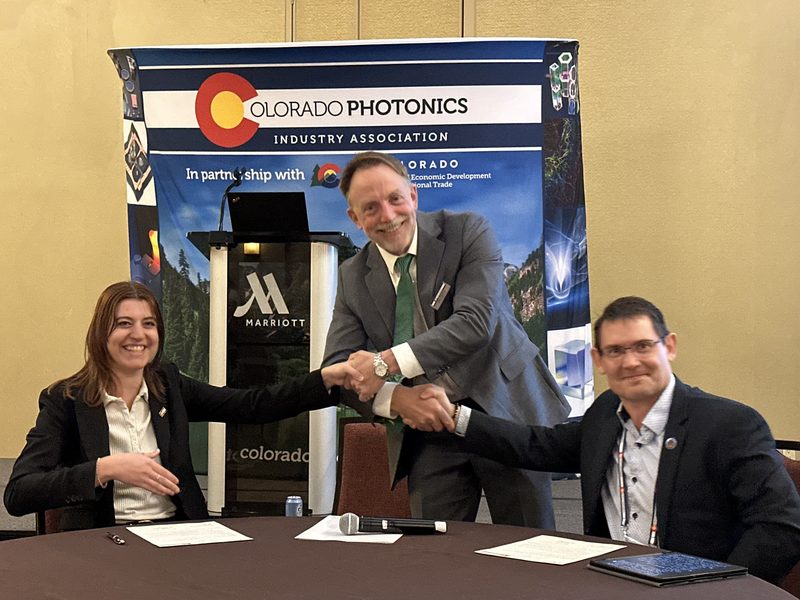
At the close of the CPIA Rocky Mountain Summit & Expo in Denver on April 17, 2026, the Colorado Photonics Industry Association and the Montana Photonics & Quantum Alliance signed a memorandum of understanding formalizing collaboration between the two regional clusters. Signed by Jenna Montague and Paul Searcy for CPIA and Jason Yager, Executive Director of MPQA. CPIA anchors a mature Colorado ecosystem spanning Boulder, Denver, Fort Collins, and Colorado Springs — including NIST, JILA, Infleqtion, Vescent, Meadowlark Optics, and Coherent’s Colorado sites. MPQA serves Montana’s photonics and quantum industry and is a central partner in the Headwaters Photonics & Quantum Tech Hub, a federally designated Regional Technology and Innovation Hub under the CHIPS and Science Act. The MOU opens the door to joint workforce initiatives, cross-state supply chain development, and coordinated federal funding engagement. The Headwaters Tech Hub Summit in Missoula (September 9–11, 2026) is the next natural touchpoint.
A team led by Professor Peter Norreys and Dr Robin Timmis at the University of Oxford, working with Queen’s University Belfast and the STFC’s Central Laser Facility, has demonstrated for the first time how to dramatically boost the intensity of a high-power laser pulse by reflecting it off a relativistically oscillating plasma — a technique that has eluded the field for more than two decades. Published in Nature on April 22, the work resolves a long-standing mismatch between theory and experiment, and the team’s simulations suggest the experiment may have produced the most intense source of coherent light ever generated. Norreys is Oxford’s Professor of Inertial Fusion Science, and the implications run straight into the IFE supply chain: more efficient coupling of laser energy into matter is exactly what commercial fusion needs. The experiment was carried out on the Gemini laser at the CLF in Didcot — a reminder that the UK’s national laser facilities remain among the most productive scientific instruments in photonics.
Marvell Technology (NASDAQ: MRVL) announced on April 22 that it has acquired Polariton Technologies, a Swiss developer of plasmonics-based silicon photonics devices. The technology combines silicon photonics with plasmonic active devices to enable modulation in the THz regime — relevant to coherent transmission, ZR/ZR+ platforms, and the industry transition from 1.6T toward 3.2T and beyond. Polariton brings a small but specialized team in plasmonics, silicon photonics, and high-speed modulation, and adds another piece to Marvell’s end-to-end connectivity portfolio across electro-optics, photonics, switching, and custom silicon. Coming a week after Credo’s acquisition of DustPhotonics, the deal underlines a clear pattern: hyperscale-scale connectivity now belongs to whoever owns the silicon photonics PIC. Financial terms were not disclosed.
Colorado State University celebrated a major construction milestone on April 24 with the placement of the final structural steel beam on the Advanced Technology Lasers for Applications and Science (ATLAS) Facility at the Foothills Campus in Fort Collins. Colorado Gov. Jared Polis attended and signed the ceremonial beam. The $160 million, 77,626-square-foot, two-story facility is anchored by a first-of-its-kind public-private partnership between CSU and Marvel Fusion, with additional support from the U.S. Department of Energy and Department of Defense. When operational, ATLAS will house three of the most powerful laser systems in the world and serve as a critical testbed for fusion energy, materials characterization, and advanced laser science. Substantial completion is scheduled for December 2026 with an official opening in 2027. The CSU effort is led by Professors Jorge Rocca and Carmen Menoni, whose decades of work in high-power lasers and high damage threshold coatings made the project possible.
The Pentagon’s FY2027 budget signals a major acceleration in high-energy laser weapons, with more than $2 billion proposed for directed energy R&D — more than double the roughly $1 billion invested annually over the past five years. The Army’s Enduring High Energy Laser (E-HEL) — its first official directed energy program of record — and the new Joint Laser Weapon System (developed jointly with the Navy under the Golden Dome missile defence strategy) are among the programs driving demand. The photonics industry implications are substantial: high-power fiber lasers, beam control optics, thermal management, and precision coatings are all in scope. Defence directed energy as a Photonics Enables theme will be explored in a future edition.
A December 2025 analysis by Woodside Capital Partners describes the optics and sensing ecosystem as experiencing its most intense acquisition cycle in years. Big Tech, defence primes, semiconductor equipment companies, and automotive firms are all competing for high-performance optical IP, sensor stacks, and laser subsystems. The report notes that photonics has moved from niche enabling technology to core infrastructure — the kind of shift that historically precedes sustained consolidation. Watch for Linda Smith’s Q1 2026 M&A report from Ceres Technology Advisors for photonics-specific deal analysis.
Canadian photonic quantum computing company Xanadu announced a SPAC merger expected to raise approximately $500M and list on Nasdaq and the TSX. Simultaneously, Xanadu and Thorlabs announced a partnership to co-develop optical fiber components addressing loss and manufacturability challenges in scaling photonic quantum systems. The pairing of a capital markets event with a supply chain partnership reflects the maturation of the photonic quantum computing sector.
The numbers tell the story: total fusion investment is forecast to reach $15 billion by year end 2026. Since 2022, operational fusion machines have increased by 15% and projects in the pipeline by 53%. The Fusion Industry Association puts private sector fundraising at $10.5 billion globally, $9 billion of it in the US. Within that, the laser-driven inertial fusion subset is where the photonics supply chain is forming — Inertia, Xcimer, Focused Energy, Longview, and Marvel Fusion are all advancing toward commercial-scale plants on roughly the same timetable. ARPA-E has added its largest-ever fusion commitment: $135 million. The old joke that commercial fusion is thirty years away and always will be has been retired. The race is on — and the laser and photonics supply chain is at the heart of it.
The U.S. Department of Labor projects 10,000 photonics job openings by 2032. The UK estimates the fusion workforce alone needs to grow by 7,000 people within ten years. The talent pipeline is not keeping pace with the industry’s ambitions — and the people who know it best are now doing something about it. Following an Optics School Summit convened by LLNL’s NIF & Photon Science directorate in January, representatives from universities and community colleges across the US have formed OPEN — the Optics and Photonics Education Network — a national alliance to share resources, best practices, and funding for optics and photonics education. Thomas Brown, director of the Institute of Optics at the University of Rochester, noted his program was established a century ago “and photonics wasn’t even a word then.” That history is now an asset — but reaching the next generation of students requires more than heritage. High school guidance counselors, science teachers as ambassadors, community college partnerships — the field needs all of it. The bottleneck is not technology. It is people.
At the SPIE Photonics Europe Marketplace presentation in Strasbourg on April 14, SPIE’s Director of Technology Outreach Amy Hanlon updated the industry forecast: 7.5% growth projected for 2025 and roughly 20% growth from 2024 to 2026, with baseline-to-high ranges of $410–421 billion in 2025 and $460–495 billion in 2026. The 2024 baseline of $381 billion already supports a multi-trillion-dollar enabled-products market. The methodology draws on analyst projections for 355 companies covering about 80% of core photonics revenue, with a median of six to seven analysts per company — this is data, not back-of-the-envelope. Over 12 years SPIE has tracked photonics revenue growing at 6.3% annually against global GDP at 3.2%, roughly twice the rate. The shape of the industry is also worth noting: 5,417 companies, nearly 1.5 million people, and 313 firms (5.8%) generating 87% of global revenue. Most growth in company count is in the $1–10 million range — a sign that the long tail is alive and innovating, even if the headline numbers come from the giants.
“Nothing travels faster than the speed of light, with the possible exception of bad news, which obeys its own special laws.”
— Douglas Adams, Mostly Harmless
Did you know?
A single optical fiber thinner than a human hair can carry enough data to stream every movie ever made — simultaneously — to millions of people at once. The internet you are reading this on is made of glass and light.